FISTERRA · COSTA DA MORTE · GALICIA
Fisterra brings together history, pilgrimage, shipwrecks, myths and one of Galicia’s most sought-after sunsets: a place where, for centuries, Europe imagined the land came to an end.
Some places are visited; others are reached.
Fisterra belongs to the second kind. The Atlantic, the lighthouse, the Camino de Santiago and the ancient idea of the end of the world make this corner of Galicia a landscape that is felt as much as it is seen.
Cape Fisterra —Finisterre in Spanish and in much of the historical tradition— projects into the Atlantic at the end of a narrow, rocky peninsula on the Costa da Morte. Here the horizon takes over almost everything you see. That position explains why the place became linked in antiquity to the idea of finis terrae, why it eventually became a natural continuation of the Camino de Santiago and why, on clear evenings, pilgrims and travellers gather by the sea to wait for the sun to disappear. For me, Fisterra is also personal: I made one of my most special photographs here one day before finishing my Camino in Muxía.
01 · WHERE IT IS
A peninsula between the Corcubión estuary and the open Atlantic
Fisterra occupies one of the most recognisable profiles on the Costa da Morte: a tongue of land reaching into the ocean and changing character completely depending on which side you stand.
The municipality of Fisterra lies in the province of A Coruña. A sandy isthmus connects the mainland to the rocky headland. To the east, the coast faces the Corcubión estuary and is more sheltered; to the west, the land receives the Atlantic swell and storms head-on.
This contrast is clear around Langosteira, a long and relatively sheltered beach, compared with Mar de Fóra and O Rostro, both open to the ocean. Within only a few kilometres, a calm bay gives way to cliffs, wind and spray.
Fisterra and Finisterre
Fisterra is the official Galician name. Finisterre is the traditional Spanish form. Both come from the Latin finis terrae: “end of the earth”.
02 · THE END OF THE WORLD
When the horizon seemed to mark the limit of the known land
The myth of Fisterra grew from an extreme geography and an unforgettable image: the sun sinking directly into the ocean.
For travellers arriving from inland Europe, this Atlantic edge could genuinely feel like the end of known territory. Beyond it there were no cities, roads or mountains, only water stretching to the horizon. That gave Galicia one of its most powerful images: the place where the world ends and something unknown begins.
Classical tradition says that the Roman general Decimus Junius Brutus reached this coast in the 2nd century BC and watched the sun disappear over the ocean. Later accounts turned the episode into part of Fisterra’s mythology: the sun descending to the sea as though it were leaving the world.
Fisterra is not the westernmost point of mainland Europe, but that does little to weaken its symbolic power. From the headland, the Atlantic fills the view until there is no land ahead.
03 · BEFORE THE CAMINO
Megaliths, hillforts and the ancient cult of the sun
Long before Christian pilgrims arrived, the Atlantic edge was already loaded with symbolism.
The Costa da Morte belongs to one of Galicia’s great megalithic areas. In Fisterra there are documented burial mounds, hillfort remains and traces of settlement far older than Roman rule. Monte do Facho, above the cape, also concentrates many of the legends and rituals associated with this landscape.
The best-known story is the Ara Solis, the supposed Altar of the Sun. Tradition claims that a place of solar worship stood on the cape and that the Romans found earlier rites connected with sunset. Some versions attribute it to pre-Roman peoples, others to the Phoenicians. History and legend cannot be completely separated here.
Christian tradition later absorbed the symbolism. One story says Saint James ordered the pagan altar destroyed, replacing the cult of the sun with a Christian reading of the edge of the world.
History and oral tradition
The burial mounds and hillforts belong to the archaeological record. The Ara Solis survives above all through tradition and later legendary sources.
04 · THE CAMINO BEYOND SANTIAGO
Walking beyond the destination until the Atlantic appears
Santiago de Compostela is the great Jacobean destination, but for thousands of pilgrims the journey continues for almost ninety kilometres to Fisterra.
The Camino to Fisterra and Muxía is unique among the Jacobean routes because it starts in Santiago and heads west. The official distance is about 89 kilometres to Fisterra, passing through Negreira, Xallas, Olveiroa and Hospital, where the route divides towards the two Atlantic endings: Fisterra and Muxía.
The connection with pilgrimage is not recent. Medieval and early modern texts document travellers continuing from Compostela towards the cape and coastal shrines. Santa María das Areas, on the road from town to the lighthouse, became one of the key religious points and houses the Holy Christ of Fisterra.
The route ends symbolically by the lighthouse, where the kilometre 0 marker has become one of the Camino’s most photographed images. From the town itself, just over three kilometres remain uphill.
Pilgrims who can document the route may request the Fisterrana, the official certificate of arrival. Those who want to continue can walk on to Muxía via Lires.
A route that keeps growing
Sensors installed in 2025 recorded more than 23,000 pilgrims continuing towards Fisterra or Muxía between early August and 21 September, with some days reaching around 400 walkers at either destination.
05 · THE LIGHTHOUSE AND COSTA DA MORTE
A light built for a coast that was never easy
The Fisterra lighthouse was built not as a tourist monument but as an essential aid to navigation on one of Galicia’s most dangerous stretches of coast.
The lighthouse was built in 1853 at about 138 metres above sea level. At the end of the 19th century a powerful fog signal was added, popularly known as the Vaca de Fisterra, or “Fisterra Cow”, because its sound resembled a bellow.
The Semaphore building, erected in 1879, transmitted signals to shipping. Offshore lies O Centolo, a rocky islet associated with several maritime accidents. The local council records a long history of disasters on this coast, including around 140 shipwrecks over a period of one hundred years.
Stories also speak of raqueros, coastal people said to have caused shipwrecks so they could loot the vessels. The Concello itself warns that these tales belong far more to popular imagination than to proven fact.
06 · SUNSET
When hundreds of people wait together for the sun to touch the Atlantic
Fisterra’s sunset has changed from an ancient source of wonder into a contemporary collective ritual.
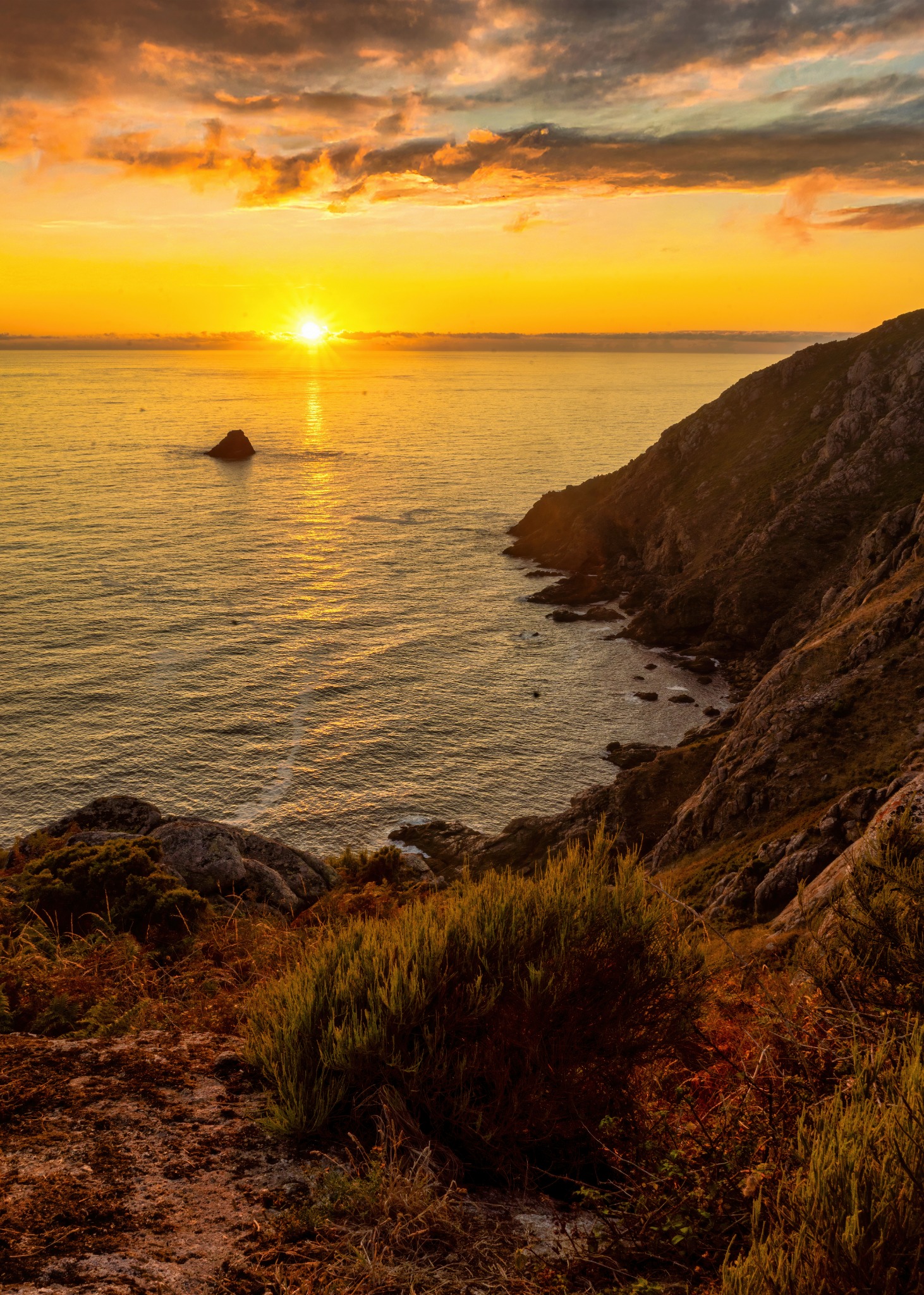
Golden sunset in Fisterra · Costa da Morte, Galicia · View the photograph →
There is no public counter separating visitors who come only for sunset. There are, however, recent figures that show the scale of the place. The first visitor counter near the lighthouse recorded 25,942 visits in April 2025, with a particularly strong concentration during Easter. In high season, Galician media describe hundreds of people gathering each evening around the lighthouse and rocks to wait for sunset.
Pilgrims with backpacks mix with families, photographers and travellers arriving by car. As the sun drops, people take their places around the headland. When the disc disappears into the Atlantic, spontaneous applause is not unusual.
What is striking is that today’s gathering repeats the same basic gesture that has defined Fisterra for centuries: facing the horizon and watching the sun vanish into the ocean.
It does not have to be empty to feel special
Fisterra can be very busy at sunset, especially in summer and on holidays. Even so, as the sun approaches the horizon, a strange hush often settles in and almost everyone looks in the same direction.
07 · MY FISTERRA
The photograph I made one day before finishing the Camino in Muxía
Some photographs remember a landscape; others end up remembering an entire moment in life.
I made this photograph in Fisterra during my Camino de Santiago, one day before finishing in Muxía. That makes it much more than a beautiful sunset for me. I was very close to the end of a journey measured for days in kilometres, walking, arriving, resting and starting again.
Reaching Fisterra at that point felt different. After roads, villages and paths, everything suddenly opened onto the Atlantic. There was no next line of land ahead. The light fell over the water, the cliffs turned dark in the foreground and the horizon became the real subject.
In the photograph I wanted to keep exactly that feeling: the low sun creates a golden path across the sea while the rocky coast and vegetation remain in shadow, carrying the eye from land towards ocean.
The following day I would finish the Camino in Muxía. Fisterra therefore stayed with me not as the final point, but as the moment immediately before the end.
08 · MYTHS AND LEGENDS
Orca Vella, the Pedras Santas and the rites of San Guillermo
Few places in Galicia bring together so many stories about death, fertility, the sun and passage into another world.
Orca Vella. One of Monte do Facho’s darkest legends tells of a woman associated with magic who chose this place to die, dug her own grave and was buried with an enchanted shepherd while snakes prevented others from saving him.
The Pedras Santas. Two large rounded stones on the headland were believed to have extraordinary properties. Tradition said the Virgin rested on them and that, although teams of oxen could not move them, a person could make them rock with one finger.
San Guillermo and fertility. The remains of the San Guillermo hermitage are linked to old fertility rites. Couples unable to have children were said to sleep on a large stone slab in the hope of conceiving.
The Ara Solis. The central myth is the supposed altar to the sun that may have occupied this Atlantic edge before Christianity, turning sunset into a symbolic frontier between light and darkness, land and sea.
09 · THE CHRIST OF THE GOLDEN BEARD
A medieval sculpture surrounded by miracles and sea stories
Fisterra’s spirituality does not end at the cape: it is also deeply tied to Santa María das Areas and its Holy Christ.
The church of Santa María das Areas stands on the road between the town and the lighthouse. Construction began in the 12th century and the building combines Romanesque, Gothic and Baroque elements added over time.
Inside is the Santo Cristo da Barba Dourada, a 14th-century Gothic sculpture surrounded by legends. One tradition says the figure reached Fisterra by sea after falling from a ship during a storm; others tell of miracles and conversions.
Its location before the final ascent to the lighthouse creates a striking sequence: religious space first, then the climb, and finally the ocean.
10 · BEYOND THE LIGHTHOUSE
Harbour, beaches, castle and a coast worth more than a few hours
Reducing Fisterra to its lighthouse means missing much of the place: the fishing town and its two coastal faces complete the experience.
The harbour remains central to local life. Fishing is part of Fisterra’s identity, and nearby stands the 18th-century Castillo de San Carlos, now home to the Fishing Museum.
Langosteira offers around two kilometres of sand and is used by many pilgrims approaching Fisterra. On the other side of the headland, Mar de Fóra is a different world: open sea, wind, strong surf and a greater feeling of isolation.
Further north, O Rostro preserves almost three kilometres of beach and dunes. Together these landscapes show that the Costa da Morte is not simply a chain of viewpoints, but a sensitive Atlantic ecosystem.
11 · CURIOSITIES AND RITUALS
What is told, what we know and what is best left behind
Fisterra carries so much symbolism that some modern customs have become mixed with traditions that are far older.
Kilometre 0 is not the official end of the Camino de Santiago. Santiago de Compostela remains the principal Jacobean destination. The marker at the cape represents the end of the extension to Fisterra.
Fisterra is not the westernmost point of Europe either. Its identity as the “end of the world” is cultural and historical rather than a modern geographical record.
Burning boots or clothes is not responsible. The practice became popular as a symbol of purification, but fires and abandoned objects damage the natural environment. The best ritual is still the simplest: watch the sunset and leave no trace.
The ending can continue. Many pilgrims go on from Fisterra to Muxía. The route leaves room for each walker to decide where the Camino truly ends.
FISTERRA AT A GLANCE
The essentials for understanding the end of the world
Location
Costa da Morte, A Coruña, on a headland between the Corcubión estuary and the open Atlantic.
Name
Fisterra and Finisterre derive from finis terrae, “end of the earth”.
Camino de Santiago
About 89 km from Santiago. The route can continue to Muxía.
Lighthouse
Built in 1853 at roughly 138 metres above sea level.
My memory
The sunset I photographed one day before finishing my Camino in Muxía.
Why Fisterra deserves much more than a sunset
The sunset may be Fisterra’s best-known image, but the place becomes far more interesting when its layers are understood. The cape was an imagined boundary of the world, a landscape of ancient beliefs and legends, a reference point for sailors, a scene of shipwrecks and a destination for pilgrims who chose not to stop in Santiago.
The lighthouse, Santa María das Areas, Monte do Facho, the harbour, Langosteira and the Atlantic beaches all belong to the same story: a community that has always lived facing the sea. And after dates, legends and data, the simplest experience remains the strongest — sitting by the ocean and waiting for the light to fall.
BRING THIS LIGHT HOME
My Fisterra sunset
The photograph featured in this article is part of my landscape collection and is available as a metal print through Displate.
— Golden sunset over Finisterre on the Atlantic coast of Galicia