CAP MARTINET · IBIZA
Cap Martinet reveals an Ibiza of cliffs, old place names and modern architecture, with Dalt Vila beyond and the Mediterranean always present.
Cap Martinet lies very close to Ibiza Town, yet its coastline can still feel remote.
Among cliffs, weathered rock, small coves and paths above the Mediterranean are traces of an island that existed before the luxury now associated with this area.
From Talamanca and Jesús, the land reaches into the sea to form one of the most recognisable headlands on this side of Ibiza. Today Cap Martinet is also a residential area close to Vila, but at the cliff edge the rock, open water and Mediterranean light take over again. It is precisely this coastline that interests me as a photographer, and it is behind the first Cap Martinet image to enter my collection.
01 · WHERE IT IS
A headland between Talamanca, Jesús and the open sea
Just a few kilometres from Vila, Cap Martinet closes the eastern side of the bay and opens the coast towards a much rockier profile.
Cap Martinet lies on the coast of Jesús, in the municipality of Santa Eulària des Riu and very close to Ibiza Town. From its higher ground there is a broad view across Vila bay: Talamanca, the islands and land around the port, the walls of Dalt Vila and, to the south, a coastline continuing towards Platja d’en Bossa and ses Salines.
To the east, the landscape changes. Cala Roja sits beneath the relief and the coastline continues through cliffs and rocky points. It is a rapid transition between urban Ibiza and a rougher shore, where wind, water and salt once again explain the shape of the land.
Two sides of the same headland
From one side, Cap Martinet looks towards Vila and its walls. From the other, the coast breaks into rock, small coves and open Mediterranean.
02 · THE FRIARS OF THE WIND
Es Frares, an old name hidden among the rocks
One of the headland’s most distinctive formations preserves a place name that almost disappeared from everyday memory.
Between the cliffs of Cap Martinet and Cala Roja, a rocky formation reaches into the sea known as es Frares de Cap Martinet. It has also been called es Picatxos de Cap Martinet. Its narrow, vertical profile is the visible result of the continuous erosion of wind, water and salt.
What makes it especially interesting is not only its shape, but the survival of its name. Archduke Ludwig Salvator referred in the nineteenth century to the “friars of Martinet” in his writings on the Pityusic Islands, although their exact location was not perfectly defined. Later research into local place names helped connect that reference with this corner of the headland.
It is one of those places where the landscape has two layers: what we see and what we call it. When a place name disappears, the rock remains unchanged, but we lose part of the way earlier generations understood that place.
03 · A COAST THAT HAD TO WATCH THE SEA
When the horizon meant more than scenery
For centuries, living on Ibiza meant sharing the Mediterranean with trade and communication, but also with danger.
Ibiza’s history is deeply connected with the need to watch its coastline. Corsair and pirate raids help explain many of the towers, fortifications and churches conceived as places of refuge that still form part of the island landscape. The sea was an essential route of communication, but also the direction from which danger could arrive.
Cap Martinet’s position helps us imagine that relationship with the horizon. From its higher ground, the view extends across a large stretch of coast and sea. There is no need to turn the headland into the setting for a particular legend to understand that, for centuries, looking towards the Mediterranean meant something very different from what it does today.
Defensive Ibiza
Coastal towers, walls and fortified churches recall a Mediterranean that for centuries had to be watched as a frontier as well as embraced as a route to the wider world.
04 · MODERN IBIZA
Can Pep Simó and the houses that changed Cap Martinet
In the 1960s, modern architecture found here a way to enter into dialogue with Ibiza’s traditional forms.
The contemporary transformation of Cap Martinet has an especially interesting chapter in Can Pep Simó. Between 1964 and 1969, Josep Lluís Sert, together with Germán Rodríguez Arias and Antoni Ferran, developed a residential complex born from a fascination with traditional Ibizan architecture.
Sert, one of Spain’s major twentieth-century architects and a former dean of Harvard’s Graduate School of Design, had known Ibiza since the 1930s. At Can Pep Simó he translated into modern architecture elements he had observed in the island’s rural houses: white volumes, human scale, adaptation to the terrain, patios and a form of construction able to grow without losing its logic.
Those houses form part of Ibiza’s architectural history and explain a decisive stage in Cap Martinet: the moment when a landscape still defined by woodland, rock and proximity to Vila also began to become a home for a new population arriving on the island.
05 · FROM QUIET COAST TO COVETED ADDRESS
How the landscape changed without disappearing completely
Its proximity to Ibiza Town, its views and its coastline turned Cap Martinet into a residential enclave, but the edge of the headland still preserves surprisingly rugged spaces.
Over the decades, residential developments and houses occupied much of Cap Martinet’s slopes and higher ground. Its position explains much of that appeal: it is very close to Ibiza and Talamanca, yet at the same time offers open sea views and a sense of separation that grows as soon as you reach the cliff edge.
The present-day image mixes those two realities. There is a residential, sophisticated Ibiza, but also pine-covered land and scrub, dirt paths, Cala Roja and rock walls where the landscape once again imposes itself over any building. For me, that contrast is one of the keys to the place.
06 · MY CAP MARTINET
Rock, sea and the first Mediterranean light
I went to Cap Martinet to watch the sun rise and found something else as well: a spectacular cloudy sky that completely transformed the scene.
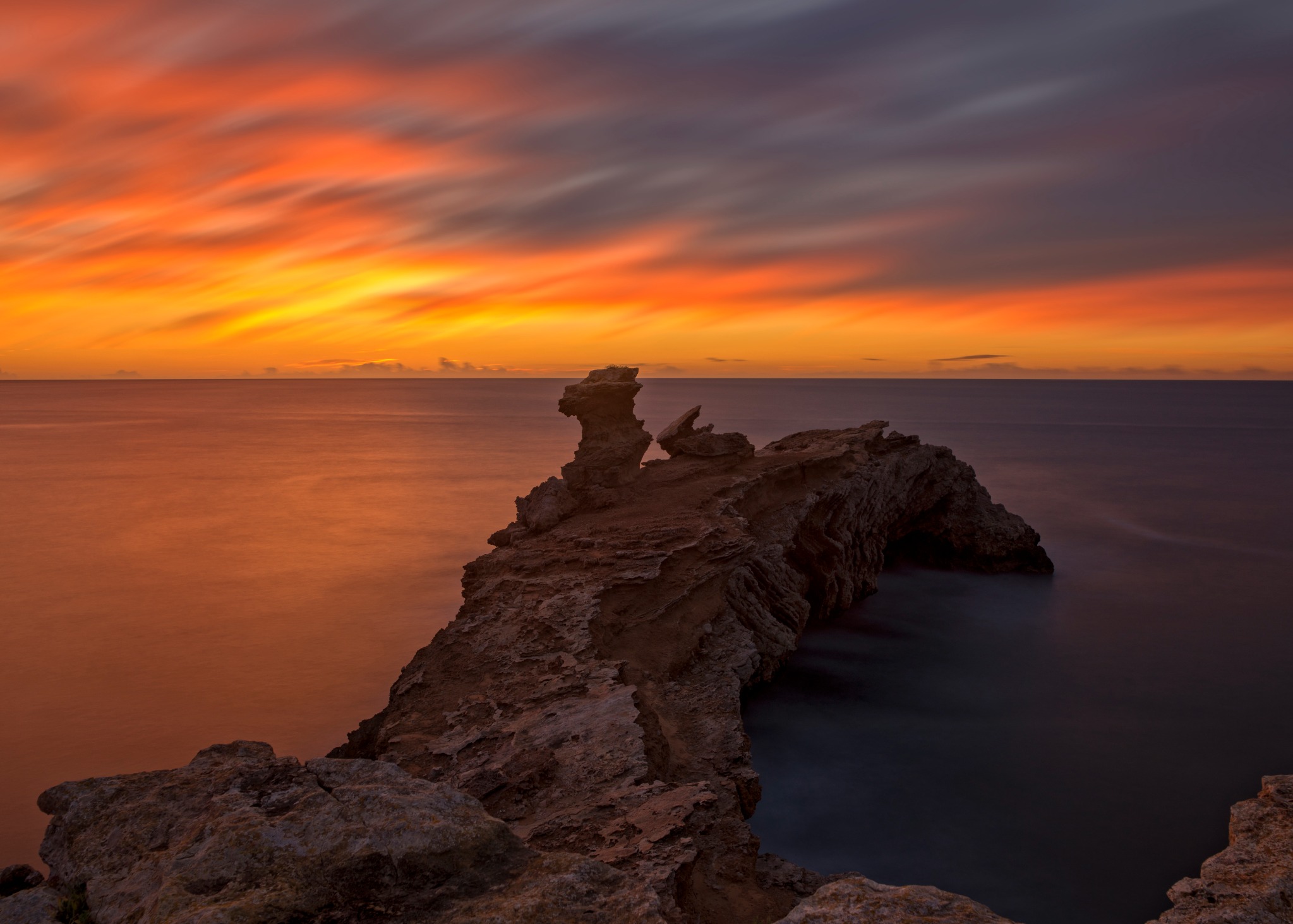
Rocky Coast of Cap Martinet · Ibiza · View photograph →
That morning I went to Cap Martinet intending to watch and photograph the sunrise. When I arrived, however, the sky was filled with clouds. Far from spoiling the dawn, they became an essential part of the photograph: they caught the light and filled the sky with colour and texture above the rocky coast.
In this image I wanted the shape of the coastline to lead the eye towards the Mediterranean. Rock occupies much of the scene and contrasts with the sea, while the first light of day breaks through the clouds and separates the different planes.
I was not trying to show the best-known or most luxurious side of Cap Martinet. I was interested in precisely the opposite: reducing the place to the elements that were here before any development. Rock, sea, clouds and that changing dawn light which, for a few minutes, transforms the way we perceive the landscape.
This is, for now, the first photograph of Cap Martinet that I have added to the collection. Over time I want to broaden this view with other images of the headland, allowing this article to grow with them and reveal different moments, light and corners of the same coastline.
What I wanted to preserve
The surprise of that sunrise: I went looking for the rising sun and also found a spectacular cloudy sky that gave the coastline an atmosphere I had not expected.
CAP MARTINET AT A GLANCE
The essentials for understanding the place
Location
The coast of Jesús, in Santa Eulària des Riu, beside Talamanca and very close to Ibiza Town.
A hidden name
Es Frares de Cap Martinet preserves an old place name linked to one of the headland’s most distinctive rock formations.
Architecture
Can Pep Simó turned this area into a landmark of modern architecture inspired by Ibiza’s traditional forms.
My photograph
A sunrise over the rocky coast, with the first Mediterranean light breaking through a spectacular cloudy sky.
Why Cap Martinet deserves to be seen beyond its villas
Cap Martinet is often associated with one of Ibiza’s best-known residential areas, but stopping at that image means missing much of what makes the place interesting. The headland remains, above all, a piece of coastline: rock entering the sea, cliffs, small coves and a privileged position overlooking Vila bay.
The old names of its rock formations, the defensive memory of an island that for centuries had to watch the horizon, and Sert’s architecture tell different stages in the relationship between landscape and human presence. Photographing it adds another, much more recent and personal layer to a coastline that has been observed from land and sea for centuries.
BRING THIS LIGHT HOME
My first photograph of Cap Martinet
This photograph is part of my work on Mediterranean landscapes. It is the first image of Cap Martinet to enter my collection and is available as a metal print through Displate.